 ultimate-guide
Ordering Pizza for Large Groups: A Complete Guide
Table of Contents
- How to Calculate Slices Per Person for Ordering Pizza for Large Groups
- How Much Pizza to Order for 20 People (and 30, 40, or More)
- Catering vs. Standard Delivery: Which Fits Your Event?
- Pizza Catering Tips for Events: Menu Variety and Dietary Needs
- How to Keep Bulk Pizza Delivery Warm Until Serving
- Bulk Order Logistics: Lead Times, Delivery Windows, and Budgeting
- Waste Management and Leftover Strategies for Group Orders
- Conclusion: Stress-Free Ordering Pizza for Large Groups
- Frequently Asked Questions
Last Updated: October 4, 2026
How to Calculate Slices Per Person for Ordering Pizza for Large Groups
Ordering pizza for large groups comes down to one number: slices per person. At Famous Pizza, we have fed crowds across Rhode Island and Massachusetts for over 20 years, and the pattern has not changed: most hosts order too little, panic, and add a second round.
The industry rule of thumb is straightforward. A standard large pizza is cut into 8 slices, and a hungry adult eats about 3 of them. So a party of 20 adults needs roughly 60 slices, or 8 large pizzas. That is your starting point, not your final answer.
The 3/8 Pizza Rule Explained
The 3/8 pizza rule is a portioning guideline that assigns three slices of an eight-slice pizza to each adult guest, with lighter eaters counted at two slices. It exists because pizza is rarely the only food on the table at a gathering, and appetites swing hard depending on the crowd.
Here is how the rule shifts by audience:
- Adults at a dinner event: 3 slices each
- Adults at a casual gathering with sides: 2 to 3 slices each
- Teenagers and college students: 4 slices each
- Children under 10: 1 to 2 slices each
- Mixed office lunch: 2 slices each
The mistake hosts make is treating every guest as an average adult. A room full of teenagers will empty a table that would feed twice as many adults.
How Much Pizza to Order for 20 People (and 30, 40, or More)
For 20 people, order 8 large pizzas. That assumes 8 slices per pie at 3 slices per adult, which lands you at 60 slices with a small buffer.
The table below gives you a working count for common party sizes. It assumes large 8-slice pizzas and a mixed crowd of adults and children.
| Party Size | Slices Needed | Large Pizzas (8 slices) | Notes |
|---|---|---|---|
| 10 people | 30 | 4 | Add 1 pie if all adults |
| 20 people | 60 | 8 | Standard mixed crowd |
| 30 people | 90 | 12 | Add 2 pies for teens |
| 40 people | 120 | 15 | Pair with sides |
| 50 people | 150 | 19 | Consider catering instead |
Two adjustments matter more than the raw math. First, if your event runs longer than two hours, people eat a second time. Add 15 to 20 percent. Second, if you are serving appetizers or a full side spread, drop each guest to 2 slices.
Catering vs. Standard Delivery: Which Fits Your Event?
Catering suits events where food needs to stay presentable for hours and someone else manages the setup. Standard delivery suits casual gatherings where speed and simplicity matter more than presentation.
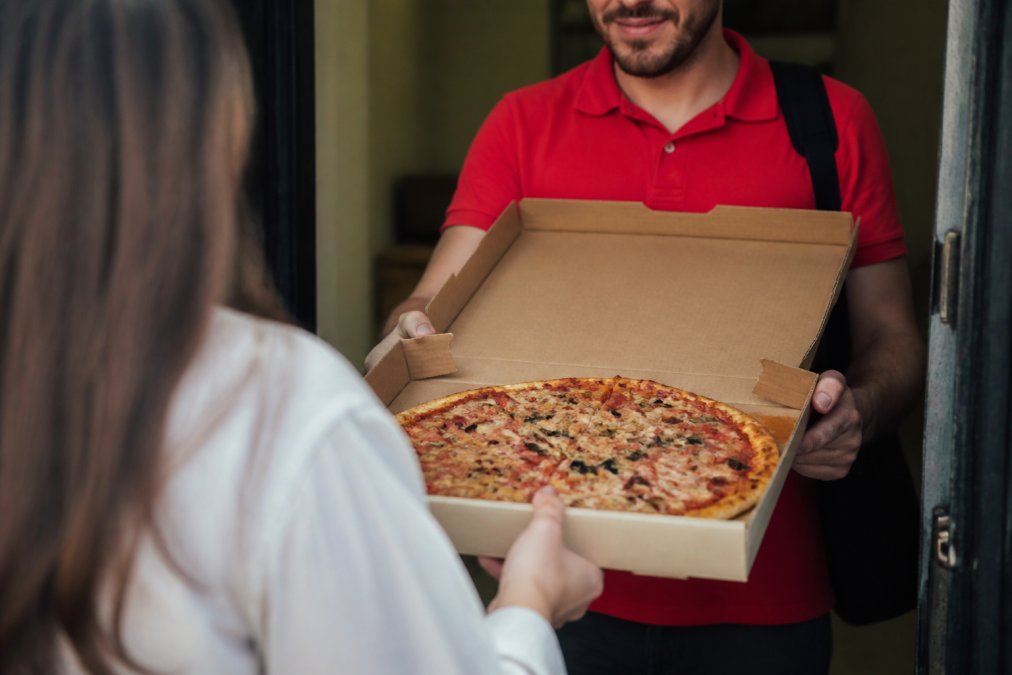
Standard delivery is the default for home parties and office lunches. Pizzas arrive hot in boxes, you stack them on a table, and people serve themselves. It is the cheapest path and the least complicated.
Catering makes sense when you cross into logistics that delivery cannot handle:
- Guest counts above 40 where you need consistent portions
- Venues without a kitchen or warming space
- Events with a fixed serving window, like a corporate lunch or a school function
- Menus that need sides, salads, and beverages coordinated together
The trade-off is lead time. Catering orders typically need advance notice, while standard delivery can often turn around same-day.
Pizza Catering Tips for Events: Menu Variety and Dietary Needs
Menu variety is what separates a pizza order that works from one that stalls. A single topping across 15 pies means a third of your guests eat nothing. Build your order around three or four crowd-pleasers, then add specialty pies for the rest.
A reliable split for a large order:
- 50 percent: classic crowd-pleasers like cheese and pepperoni
- 25 percent: one or two specialty pizzas with broader appeal
- 15 percent: vegetarian options
- 10 percent: dietary-specific pies
Crust matters as much as toppings. Offering one thin-crust and one thicker-style option covers most preferences without doubling your order. Appetizers and side dishes also stretch a pizza order further, and a simple salad or wings line reduces how many slices each guest takes.
Handling Gluten-Free, Vegetarian, and Vegan Requests
Gluten-free, vegetarian, and vegan requests need separate handling, not a shared pie with toppings picked off. Cross-contact is the real risk, and guests with celiac disease or a dairy allergy will notice.
A few practical rules we follow:
- Order gluten-free pies separately and label the boxes clearly
- Keep vegan pizzas free of cheese entirely, not just light on it
- Confirm with your pizza shop how they handle cross-contact before you order
- Ask guests about dietary restrictions when you send the invitation, not at the door
For guidance on food allergen handling, the FDA guidance on food allergens outlines how major allergens must be managed in food service. If your group has someone with a serious allergy, call the shop directly and ask how they prepare specialty pies.
How to Keep Bulk Pizza Delivery Warm Until Serving
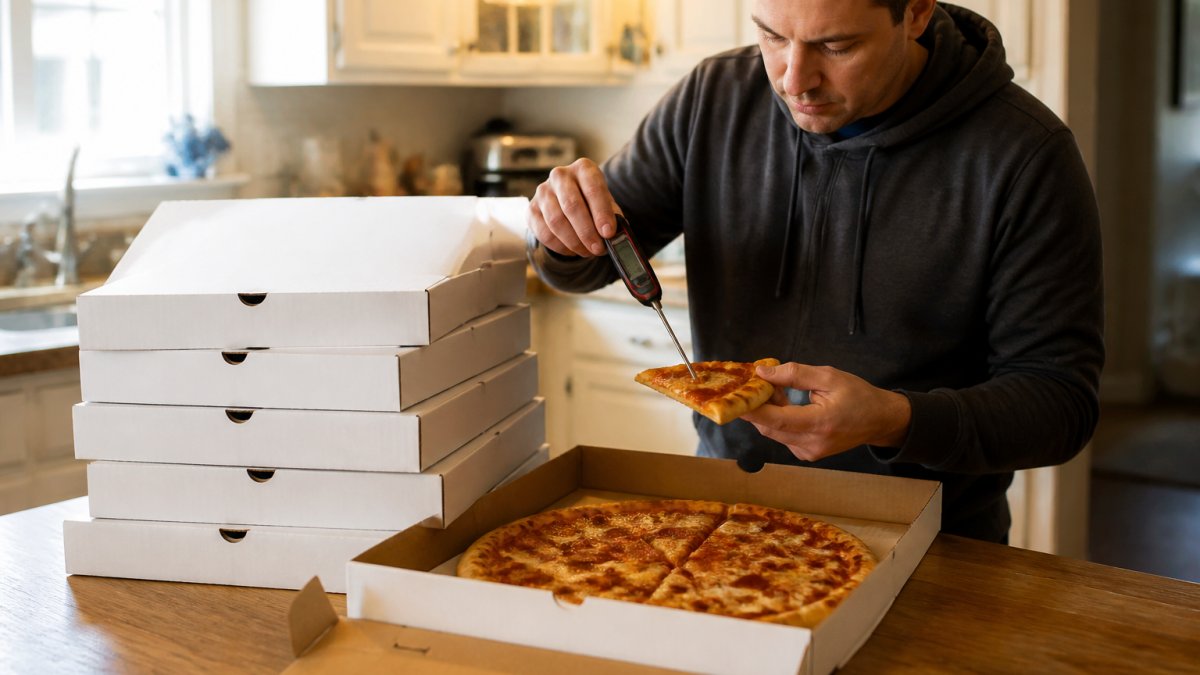
Keeping bulk pizza warm comes down to three things: insulation, stacking, and timing. A closed box holds heat for roughly 20 to 30 minutes. After that, the crust softens and the cheese sets.
What works in practice:
- Keep boxes closed and stacked. Open boxes lose heat fast.
- Skip the oven for stacked boxes; a low oven dries out crust and makes boxes a fire risk.
- Use a cooler with a towel on the bottom for short holds. It traps steam and heat together.
- Serve in waves if your order is large. Put out half the pies, then bring out the rest.
The single biggest mistake is ordering too early. A delivery that arrives 45 minutes before guests do will be lukewarm by the time anyone eats.
Bulk Order Logistics: Lead Times, Delivery Windows, and Budgeting
Bulk order logistics start with lead time. For groups under 20, same-day ordering is usually fine. For 20 to 50 people, give the shop at least 24 hours.
Delivery windows matter as much as lead time. Large orders take longer to prepare and longer to deliver, so a shop cannot promise the same 20-minute turnaround it gives a single-pie order.
Budgeting for a large order has three parts:
- Food cost: driven by pie count and topping choices
- Service fee: some shops add a fee on large or catered orders
- Gratuity: standard for delivery, and worth planning for on big orders
We do not publish fixed pricing because cost depends on quantity, toppings, and delivery distance. Call us or order online for a current quote on your group size.
Tipping and Service Fees for Large Orders
Tipping on a bulk order follows the same logic as any delivery: the driver handled more food, more boxes, and often more trips.
Service fees are separate from tips. Some shops apply a fee to large or catered orders to cover packaging and coordination. For general guidance on tipping expectations in food service, the U.S. Department of Labor guidance on tipped employees explains how tips and service charges are treated differently.
Waste Management and Leftover Strategies for Group Orders
Leftovers are not a failure. They are the buffer that keeps your last guests from going hungry. The goal is to end the event with a small surplus, not a mountain of cold pizza.
Plan for roughly 10 percent overage on your slice count. That covers late arrivals and second helpings without leaving you with 20 uneaten slices.
How to handle what is left:
- Cool quickly. Leftover pizza should go into the fridge within two hours of serving.
- Label by type. Gluten-free and vegan leftovers need separate containers.
- Send guests home with boxes. Most people are happy to take a slice or two.
- Reheat smart. A skillet or oven at moderate heat brings crust back better than a microwave.
Corporate events and social gatherings waste differently. Corporate lunches often end abruptly when the meeting does, leaving full boxes behind. Social events wind down gradually, so leftovers get picked at. For corporate orders, order closer to your minimum and keep a small reserve.
Conclusion: Stress-Free Ordering Pizza for Large Groups
The hard part of feeding a crowd is not the pizza. It is the math, the timing, and the small details that decide whether guests eat well or wait.
That is where we come in. Famous Pizza has been family-owned and operated for over 20 years, serving Rhode Island and Massachusetts with homemade pizza and grinders built for weeknight dinners and casual gatherings alike.
Get started with Famous Pizza and let us handle the pies, the timing, and the details so you can focus on your guests. Order online today.
Frequently Asked Questions
How many pizzas do I need to feed 30 adults?
For 30 adults, plan on 2 to 3 slices per person if you have sides, or 3 to 4 slices if pizza is the main meal. A large pizza typically has 8 slices, so you would need about 12 to 15 large pizzas for a full meal. If you are also serving appetizers, salads, or side dishes, you can order closer to 10 to 12 pizzas. Always confirm your crowd's appetite and whether there are other food options available.
What is the 3/8 pizza rule for catering?
The 3/8 pizza rule suggests ordering three slices per person for every eight people. In practice, this means for a group of 16, you would order six large pizzas (48 slices). The rule works well for mixed groups with average appetites and when some sides are available. For groups with more men or teenagers, bump it up to four slices per person. For lighter eaters or events with many side dishes, three slices per person is usually enough.
How far in advance should you place a large pizza order?
For groups of 20 or more, place your order at least 24 to 48 hours ahead. For 50 or more people, give 3 to 5 days' notice, especially on weekends. Many pizza places need advance notice for bulk orders to ensure they have enough dough, toppings, and staff. If you are ordering for a holiday or a busy Friday night, call even earlier. Famous Pizza recommends calling directly for large group orders to confirm timing and availability.
How do you keep pizza warm for a large group event?
Use insulated pizza bags or coolers lined with clean towels to keep boxes warm during transport. At the venue, stack boxes and cover them with a heavy blanket or foil. If you have access to an oven, warm slices at 250°F for 5 to 7 minutes before serving. Avoid microwaving, which makes crust soggy. For outdoor events, use chafing dishes or warming trays. Plan to serve within 30 to 45 minutes of delivery for the best texture and warmth.
What are the best pizza toppings for large group orders?
Stick with crowd-pleasers: pepperoni, cheese, sausage, and mushroom. Order at least half of your pizzas as plain cheese or pepperoni, since these are the most universally liked. Add one or two specialty pizzas for variety, like a veggie or supreme. Avoid heavy or controversial toppings like anchovies or jalapeños unless you know your group well. Offering a mix of red and white pizzas also helps cover different preferences without overcomplicating the order.
Should I tip on a large pizza delivery order?
Yes, tipping is standard for large delivery orders. For a bulk order, 10% to 15% of the total is typical, or $2 to $5 per pizza for smaller orders. If the delivery involves setup or multiple trips, tip on the higher end. Some pizza places add a service fee or gratuity automatically for large orders, so check your receipt or ask when ordering.