 How-to
How to Find the Best Local Pizza in 2026
Last Updated: October 28, 2026
Quick Summary
To find the best local pizza, build a shortlist of three to five nearby pizzerias from a pizza-near-me search, then judge them by review patterns from recent months and by a plain cheese slice. A plain slice with an even crust, bright sauce and balanced cheese is the fairest test of a pizzeria.
- Build a shortlist of three to five restaurants and stop there.
- Weight reviews from the last 90 days most heavily and discount reviews older than a year.
- Sort by newest and read the ten most recent reviews before committing.
- Judge the crust by its underside, edge and center, and taste the sauce on a plain cheese pie.
- Set a budget before opening the menu, then choose an order that fits your occasion.
Table of Contents
- Why Finding Good Local Pizza Takes a Method
- Step 1: Search for Pizza Near Me and Build a Shortlist
- Step 2: Read Pizza Reviews and Ratings the Right Way
- Step 3: Judge Pizza Crust Styles and Sauce Quality
- Step 4: Compare Takeout and Delivery Options
- Step 5: Choose Your First Order by Budget, Diet and Occasion
- Booking Your First Famous Pizza Order
- Frequently Asked Questions
Finding good local pizza in 2026 takes more than scrolling through the first few search results. Most ratings look convincing, and most menus look appealing. Famous Pizza has over 20 years of experience as a family-owned business, and we believe a repeatable method helps any hungry family, professional or group planner choose well, wherever they live.
Here is the core problem. A top-ranked listing does not tell you whether the crust will arrive crisp, whether the sauce tastes fresh, or whether the kitchen handles a Friday rush well. Pizza is a simple food, so small differences in dough, oven heat and ingredients matter a great deal. The method below turns those differences into a checklist you can apply to any neighborhood.
Why Finding Good Local Pizza Takes a Method
Good local pizza is a judgment call, and judgment works best with a consistent process. A method keeps you from choosing based on a single glowing review or a flashy photo. It also lets you compare two pizzerias on the same terms instead of on mood.
The method has five steps: build a shortlist, read reviews critically, judge the crust and sauce, compare takeout with delivery, and then choose an order that fits your budget, diet and occasion. Each step narrows the field. By the end, you should have a clear first choice and a backup.
Step 1: Search for Pizza Near Me and Build a Shortlist
Start with a search for pizza near me, then pull up the menus of the top few results. Look for places that clearly list their signature pies, crust options and sizes. A menu that explains its dough or sauce usually signals a kitchen that takes its product seriously.
Aim for a shortlist of three to five restaurants. Include a mix of styles if you want variety. Note each place's options, since those determine how you will actually eat the meal.
Watch out: a long shortlist wastes time. Stop at five.
Step 2: Read Pizza Reviews and Ratings the Right Way
Ratings are useful, but only when you read them closely. The goal here is not to find the highest number, it is to decide whether the reviews describe the pizza you will actually receive this month. A repeatable review-reading method beats gut feel, and it is the step most readers skip.
Start with review count and recency together. A 4.8 rating from twelve reviews tells you far less than a 4.5 from several hundred. Then look at dates. Reviews from the last few months reflect current staff, recipes and prices, while older reviews may describe a different kitchen. A practical rule: weight the last 90 days most heavily, treat 3-12 months as context, and discount anything older than a year unless the pattern is consistent across many years.
Read the middle-star reviews, usually three and four stars. They tend to be specific and fair, mentioning what was good and what missed the mark. Scan for repeated words like "soggy," "burnt," "fast" or "friendly." Patterns across many reviews carry more weight than any single complaint. A single review is less informative than a pattern across multiple reviews.
Weigh review quality, not just quantity. A detailed review that names a specific pie, crust style, or wait time is worth more than a one-line "best pizza ever." Look for reviews that mention the same dish or the same issue, repeated specifics are harder to fake than repeated praise. Be skeptical of clusters of five-star reviews posted on the same day or with no detail.
Cross-check the restaurant's own menu and hours against what reviewers describe. If reviews mention a wood-fired oven but the menu lists only conveyor-baked pies, the listing is stale. If reviewers praise a gluten-free crust that no longer appears on the menu, treat the recommendation as outdated.
Finally, separate service complaints from food complaints. A slow host on a Saturday night is a different problem from a consistently underbaked crust. For a first visit, prioritize food-specific patterns; for a repeat visit, weigh service and consistency just as heavily.
Step 3: Judge Pizza Crust Styles and Sauce Quality
The crust tells you the most about a pizzeria, and the sauce tells you whether the kitchen cares. This step turns both into a short, repeatable test you can run on any pie, in any neighborhood.
Know the styles you prefer before you order. Thin crust should be crisp on the bottom and chewy at the edge. Deep dish should be golden and sturdy without tasting greasy. Tavern-style should be thin, cracker-like and cut into squares. Neapolitan-style should show a light char and a soft center. New York-style should fold without cracking and reheat well the next day. If you are unsure which style a shop makes, ask, a kitchen that can explain its own style usually understands its dough.
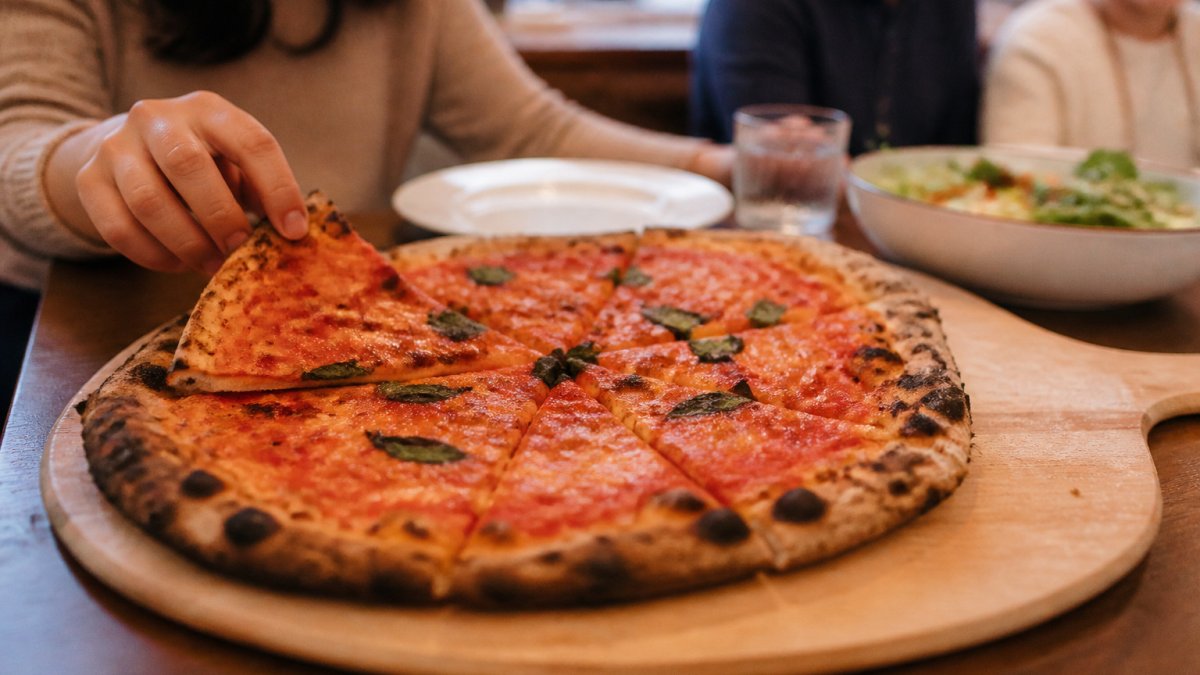
Judge the crust with three cues. First, the underside: lift a slice and look for an even bake, not pale patches next to dark ones. Second, the edge: it should be chewy, not leathery, and should not collapse when you bite. Third, the center: a properly baked slice holds its shape for a few seconds before the tip droops. A center that sags immediately usually means the dough was underbaked or overloaded with sauce and cheese.
Next, taste the sauce. Good sauce tastes bright and tomato-forward, not sugary or pasty. A simple cheese pie is the best test, because nothing hides a weak sauce or a bland dough. If your local place offers slices, order a plain slice first to judge the basics. Pay attention to the sauce-to-cheese ratio: too much cheese masks the sauce, and too little leaves the crust exposed and dry. The best pies let you taste all three, crust, sauce and cheese, in one bite.
The photograph below shows what a well-made crust looks like when it leaves the oven.
One more practical check: ask how the kitchen handles a reheat. A slice that crisps back up in a home oven without turning greasy is a good sign that the original bake was solid. If it turns limp or oily, the crust was likely underbaked or overloaded.
Step 4: Compare Takeout and Delivery Options
Takeout and delivery are different experiences, and the best choice depends on the trip.
Ask each shortlisted pizzeria about its options and current prices. Check the restaurant's own menu or call for current prices rather than relying on a third-party listing.
Step 5: Choose Your First Order by Budget, Diet and Occasion
Your first order should match what you need. For a busy family dinner or group gathering, choose an order that fits the occasion. For a dietary need, ask the restaurant about its options.
Set a budget before you open the menu, then compare options against it. Our advice is simple: choose an order that suits your needs.
Booking Your First Famous Pizza Order
If Famous Pizza is on your shortlist, you can check the menu and current pricing before you order. Famous Pizza has over 20 years of experience serving high-quality, flavorful meals in a warm and welcoming environment.
Ready to try it? Order online.
Frequently Asked Questions
How do I find the best pizza near me?
Start with a map search for pizza near you, then narrow the list to places with recent reviews. Consider the number of reviews as well as their average rating. Three to five candidates is enough to start a comparison.
What should I look for when choosing a local pizza place?
Consider what matters to you when choosing a local pizza place, and check the restaurant's menu and current pricing.
How can I tell if a pizzeria uses fresh ingredients?
You can check the restaurant's menu and ask questions about its ingredients.
Is local pizza better than chain pizza?
Quality varies by shop. You can decide what suits you by considering the options available to you.