 how-to
How to Ensure Consistent Pizza Quality Every Time
Table of Contents
- Why Consistent Pizza Quality Starts With Systems, Not Luck
- The Pizza Quality Control Checklist Every Kitchen Needs
- Standardizing Pizza Ingredient Portions for Uniform Results
- How to Train Pizza Staff for Consistency Across Every Shift
- Temperature Control and Oven Calibration for Even Baking
- Managing Dough Fermentation, Proofing, and Ambient Humidity
- Digital Tracking and Waste Reduction Without Cutting Quality
- Frequently Asked Questions
Last Updated: September 30, 2026
Why Consistent Pizza Quality Starts With Systems, Not Luck
Great pizza isn't an accident, it's the result of repeatable systems, which is the whole game when you're trying to ensure consistent pizza quality. At Famous Pizza, we've spent over 20 years running family-owned kitchens, and the hard truth is simple: consistency comes from process, not talent. A skilled cook who eyeballs every pie will drift; a documented system holds steady.
The Pizza Quality Control Checklist Every Kitchen Needs
A working checklist covers five checkpoints:
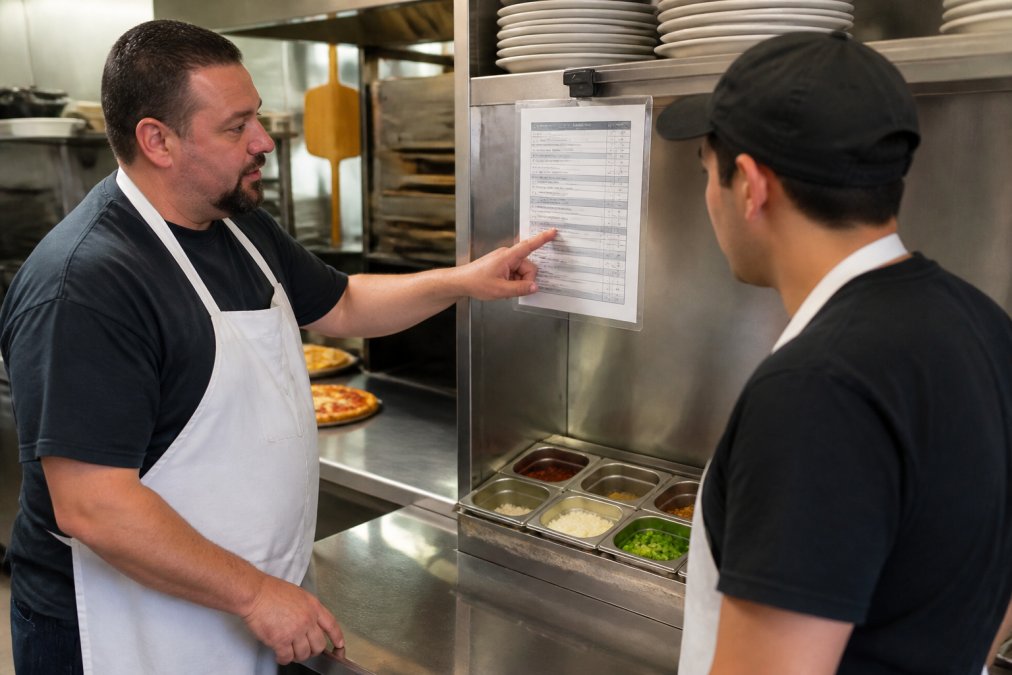
- Dough weight: Every dough ball scaled to the same gram weight
- Sauce portion: Measured with a ladle or scale, never poured freehand
- Cheese weight: Portioned by scale for even coverage
- Oven temperature: Verified with an infrared thermometer before each bake
- Bake time: Timed, not guessed
Treat the checklist as a living document and update it whenever a repeat problem appears.
Standardizing Pizza Ingredient Portions for Uniform Results
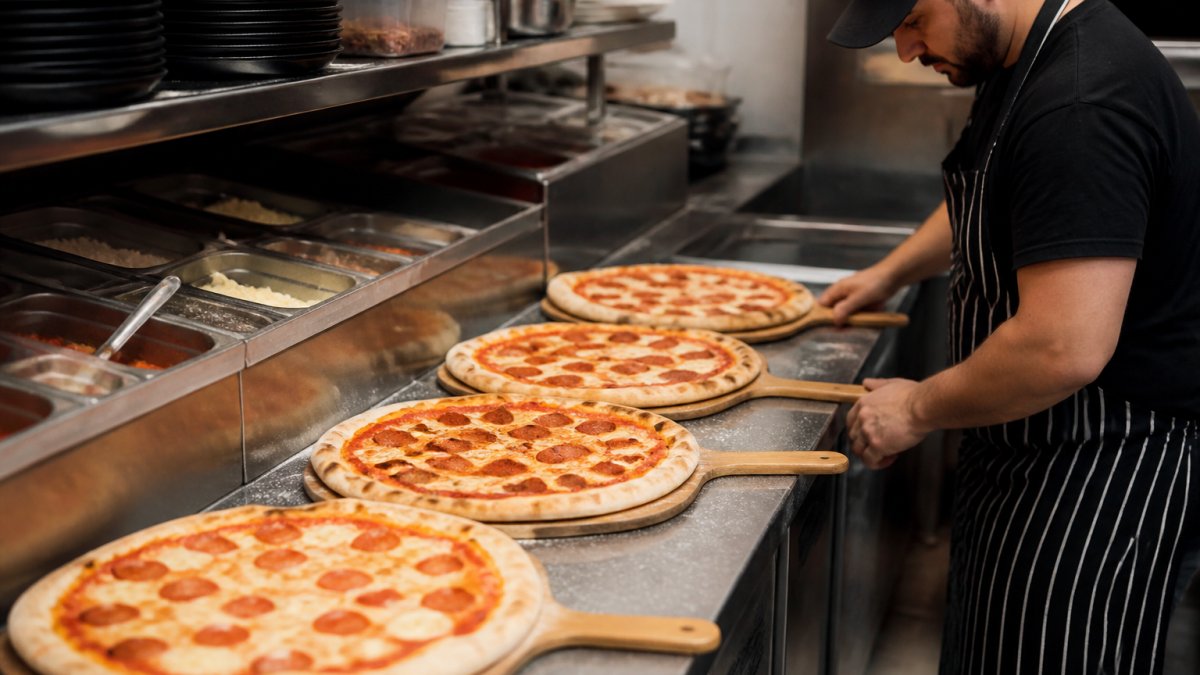
Standardizing pizza ingredient portions means measuring every topping by weight or volume instead of estimating, the fastest way to make two pizzas look and taste identical.
Using Scales and Baker's Percentage for Dough Consistency
Baker's percentage expresses every dough ingredient as a percentage of the flour weight. Flour is always 100%; everything else scales from there.
| Ingredient | Baker's Percentage | Why It Matters |
|---|---|---|
| Flour | 100% | The base for all ratios |
| Water | 60-65% | Controls hydration and crumb |
| Yeast | 0.5-2% | Drives fermentation speed |
| Salt | 2-3% | Flavor and gluten structure |
Portioning Cheese, Sauce, and Toppings by Weight
- Sauce: spread with a measured ladle, then verified on a scale
- Cheese: weighed, then distributed from the center outward
- Toppings: weighed in batches so every pie gets the same load
Even distribution matters as much as total weight. Spread toppings to the edge, leaving a consistent rim.
How to Train Pizza Staff for Consistency Across Every Shift
Training pizza staff for consistency means teaching the system, then proving each cook can repeat it. A new hire who copies what they see will copy bad habits too.
Documenting SOPs and Running Calibration Drills
Start by writing down every repeatable task. Dough mixing, sauce portioning, cheese weighing, oven loading, and cutting all get their own SOP.
- Have two cooks make the same pizza at the same time
- Weigh both dough balls on the same scale
- Compare cheese weights and bake times
- Correct any drift on the spot
Temperature Control and Oven Calibration for Even Baking
Temperature control is the difference between a crust that browns evenly and one that burns on the bottom while staying raw on top. Every oven drifts, so calibration is not optional, and "oven temperature" is four numbers working together: air temperature, stone or deck surface temperature, recovery time, and chamber humidity.
Reading the Four Temperatures That Actually Matter
A dial setting tells you what the thermostat is trying to hold, not what the pie experiences.
- Air temperature: Measured with a hanging oven thermometer or a probe clipped to a rack. This is what most cooks check, and it is the least useful on its own.
- Surface temperature: Measured with an infrared thermometer pointed at the stone, deck, or steel. This is the number that drives bottom browning. A deck reading 50°F below the air temp will produce a pale, gummy bottom even when the dial says you are at temperature.
- Recovery time: How long the oven takes to climb back to its set point after you open the door and load a pie. A loaded deck oven can drop 75-150°F in seconds. If recovery takes longer than your bake time, every pie after the first one bakes differently.
- Chamber humidity: The moisture in the air inside the oven. This is the variable almost no home guide mentions, and it is the one that separates a cracker-crisp crust from a leathery one.
Steam Injection and Why It Changes Crust Texture
Steam injection is a feature on many commercial deck and conveyor ovens and the single most underused control in pizza baking. A short burst of steam at the start of the bake does three things:
- It keeps the dough surface moist long enough for the crust to expand fully before it sets.
- It gelatinizes the outer layer of starch, which produces a glossy, blistered finish rather than a dry, floury one.
- It delays surface browning, which gives the interior time to cook through without scorching the top.
Matching Your Oven Type to Your Style
Consistency means knowing which oven you're running.
- Deck ovens hold heat in a thick stone floor. They reward a long preheat, often 45 to 60 minutes, and they punish rushed loading. Best for Neapolitan and New York styles where bottom char matters.
- Conveyor ovens trade peak heat for repeatability. Once you set time, temperature, and blower speed, every pie gets the same bake. They are the most consistent option for high-volume operations, but they rarely produce the leopard-spot char a deck can.
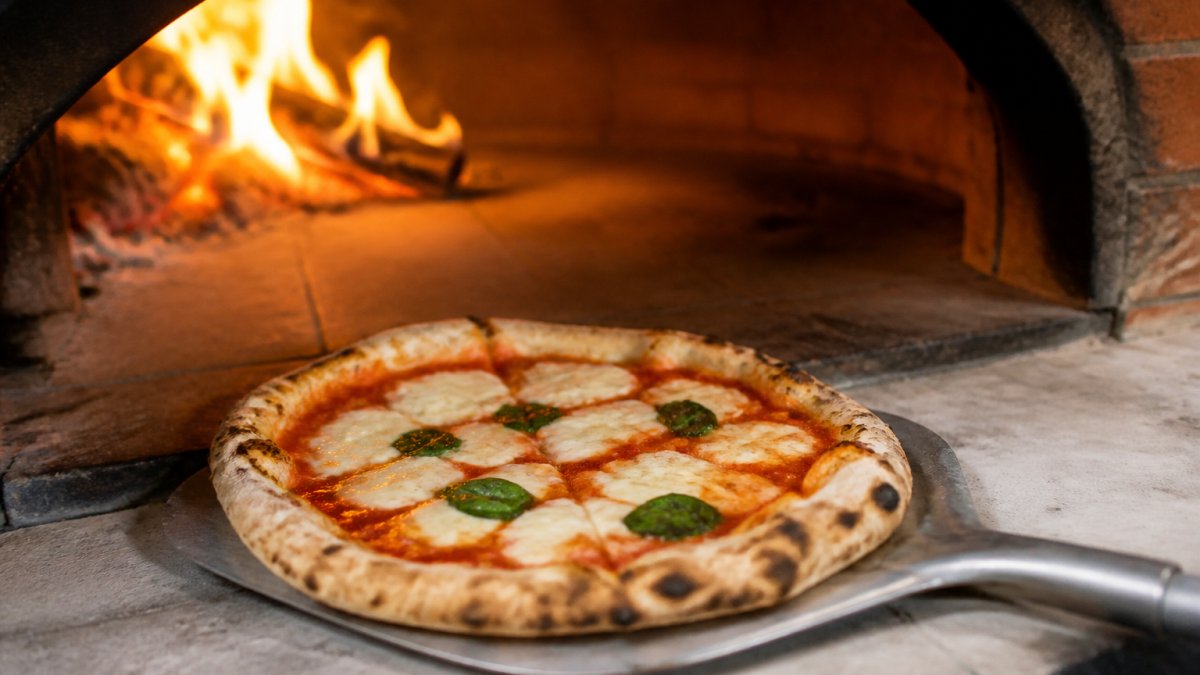
- Hearth and wood-fired ovens reach 700-900°F and bake in 60-90 seconds. They demand constant fire management and floor rotation, which makes them the hardest to run consistently without a dedicated oven tender.
Whichever you run, the rule is the same: preheat fully, load pies at the same spot, avoid opening the door more than necessary, and rotate midway for uniform browning. Log readings so you can spot a failing thermostat or cracked stone before it ruins a Friday rush.
Managing Dough Fermentation, Proofing, and Ambient Humidity
Dough management is where small changes create big swings in the final crust. Fermentation and proofing are time-and-temperature driven, so both need control.
- Track dough temperature after mixing
- Set a fixed cold-ferment window
- Time the room-temp proof, don't eyeball it
- Cover dough to lock in moisture
Digital Tracking and Waste Reduction Without Cutting Quality
Most pizza consistency guides stop at the kitchen, telling you to weigh your dough and calibrate your oven. What they miss is that consistency is a data problem as much as a culinary one: if you cannot see your numbers over time, you cannot tell whether you are holding a standard or slowly drifting away from it.
Building a Simple Consistency Log
Digital tracking does not require expensive software. A shared spreadsheet or tablet-based form beats a clipboard because it timestamps entries and charts trends. Capture the same handful of numbers every shift, at the same points in the process.
A workable log captures:
- Dough ball weight for each batch, against the target gram weight
- Sauce and cheese weight per size, sampled from a few pies per shift
- Oven surface temperature at open, mid-rush, and close
- Bake time for a reference pie, timed with a stopwatch
- Dough discard at the end of the day, in grams or balls
- Flour lot number and any hydration adjustment made for it
Reading the Trends, Not Just the Numbers
A single day of data tells you almost nothing; a month tells you which variable is drifting.
Waste Reduction Without Cutting Quality
Waste reduction and quality are not enemies. Cut waste from over-portioning and over-production, not under-portioning: if your cheese standard is a set weight and cooks hit it, waste drops and quality holds.
- Over-portioning toppings. A cook who eyeballs cheese at 20% over standard wastes more than a cook who weighs it, and the pie is worse for it.
- Over-proofing dough. Dough that sits too long gets discarded. Tracking proof times and matching batch size to forecast demand cuts this sharply.
- Remake pies. A pie that goes out wrong is the most expensive waste there is, because you lose the food, the labor, and the customer's confidence at once. Tracking remake reasons, wrong toppings, underbaked, cold, tells you which control is failing.
Managing Supply Chain Variability
Digital logs also make training easier: new cooks see the target numbers, not just hear them, and can compare their entries against the standard from day one. That turns consistency from a habit you hope for into a system you can audit.
Frequently Asked Questions
How does dough fermentation affect pizza consistency?
Fermentation determines how the dough behaves when it hits the oven. A cold ferment for 24 to 72 hours develops gluten structure and flavor, but the timing has to be tracked. If one batch proofs for 48 hours and the next for 24, the crust will brown differently and the texture will change. Keeping a fermentation log with start times, fridge temperature, and ambient humidity gives you repeatable results batch after batch.
What should be on a pizza quality control checklist?
A working checklist covers dough weight and hydration, sauce and cheese portions by weight, oven temperature and recovery time, bake time, and a visual crust check for browning and char. Add a final inspection for even topping distribution and moisture content before the pizza leaves the pass. Post it at the station and have staff initial each item so nothing gets skipped during a rush.
How do you train pizza staff to keep quality consistent?
Start with documented standard operating procedures for every station, then run hands-on calibration drills where staff weigh dough balls and portion cheese until they hit the target consistently. Pair new hires with experienced cooks for the first several shifts and do blind taste tests weekly. Cross-train so anyone can step into any station without a drop in consistency.
Why does oven temperature matter so much for consistent pizza?
Oven temperature and recovery time decide how the crust sets, how the cheese melts, and whether the bottom browns evenly. If the oven drops 50 degrees when you load three pizzas and takes too long to recover, the next pie bakes pale. Check deck temperature with an infrared thermometer every hour and give the oven time to rebound between loads. A stone hearth or steel surface holds thermal mass better than thin pans.